





0102030405
Expanded Microspheres from China Suppliers - High-Quality Factory Products for Diverse Applications
Expanded Microspheres Technical Sheet
| Product Code | Appearance | Shell Material | Average Particle (μm) | T-start (℃) | T-max (℃) | Solid Content | Operations |
|---|---|---|---|---|---|---|---|
| CYE-8008 | White powder | Acrylic copolymer | 20-35 | 135-145 | 195-210 | >97% | Inquiry |
| CYE-8018 | White powder | Acrylic copolymer | 20-35 | 140-150 | 198-210 | >97% | Inquiry |
| CYE-8009 | White powder | Acrylic copolymer | 20-35 | 150-160 | 205-215 | >97% | Inquiry |
| CYE-8019 | White powder | Acrylic copolymer | 20-35 | 145-155 | 190-200 | >97% | Inquiry |
| CYE-8029 | White powder | Acrylic copolymer | 20-35 | 150-160 | 195-205 | >97% | Inquiry |
| CYE-9006 | White powder | Acrylic copolymer | 20-35 | 155-165 | 205-215 | >97% | Inquiry |
| CYE-9016 | White powder | Acrylic copolymer | 20-35 | 150-160 | 195-205 | >97% | Inquiry |
| CYE-9036 | White powder | Acrylic copolymer | 20-35 | 160-170 | 190-200 | >97% | Inquiry |
| CYE-9007 | White powder | Acrylic copolymer | 20-35 | 150-160 | 195-210 | >97% | Inquiry |
| CYE-9018 | White powder | Acrylic copolymer | 20-35 | 155-165 | 200-210 | >97% | Inquiry |
| CYE-7018 | White powder | Acrylic copolymer | 20-30 | 120-130 | 170-180 | >97% | Inquiry |
| CYE-7008W | Filter cake | Acrylic copolymer | 10-20 | 120-130 | 160-170 | >70% | Inquiry |
| CYE-7018W | Filter cake | Acrylic copolymer | 20-30 | 120-130 | 170-180 | >70% | Inquiry |
Frequently Asked Questions
What are Expanded Microspheres and how do they work?
Expanded microspheres are microscopic polymer spheres encapsulating a pressurized gas. When heated, the thermoplastic shell softens and the gas expands, increasing the sphere volume drastically. They are widely used as lightweight fillers and blowing agents to reduce density, enhance flexibility, and improve insulation properties in plastics, coatings, and sealants.
What is the significance of T-start and T-max in the technical sheet?
T-start (℃) is the initial temperature at which the microspheres begin to expand. T-max (℃) is the temperature at which the microspheres reach their maximum expansion volume and optimal density reduction. Matching these parameters to your processing temperature prevents premature expansion or thermal degradation of the microspheres.
What is the difference between White Powder and Filter Cake appearances?
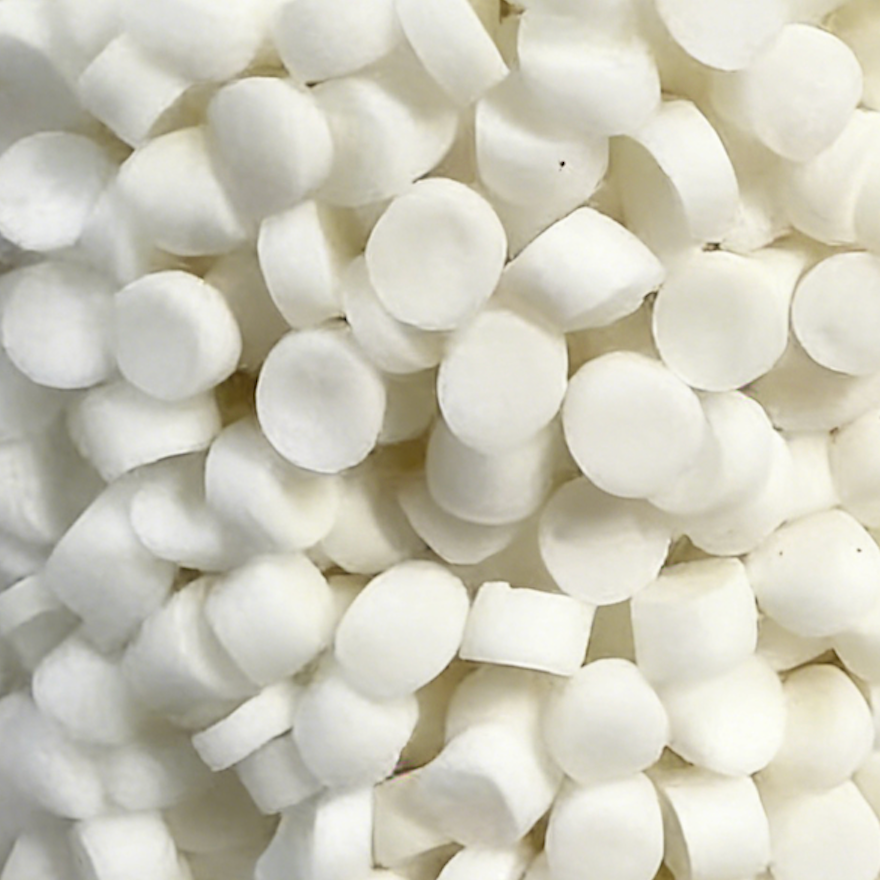
White powder forms (solid content >97%) are dry, free-flowing microspheres ideal for solvent-based systems and processes where moisture must be avoided. Filter cake forms (solid content >70%) contain water, making them dust-free, safer to handle, and easily dispersible in water-borne systems.
Why is Acrylic copolymer used as the shell material?
Acrylic copolymer provides an excellent balance of gas barrier properties, elasticity, and thermal stability. It ensures that the gas remains encapsulated during high-pressure and high-temperature processing, enabling uniform expansion and consistent cell structures in the final product.
How do I select the right average particle size for my application?
The average particle size (ranging from 10 to 35 μm) directly impacts the surface finish and mechanical properties of your material. Smaller particle sizes (e.g., 10-20 μm) provide smoother surface finishes and finer cell structures, whereas larger sizes (e.g., 20-35 μm) offer higher volume expansion efficiency.

Get in touch
We're Ready To Assist You Anytime