



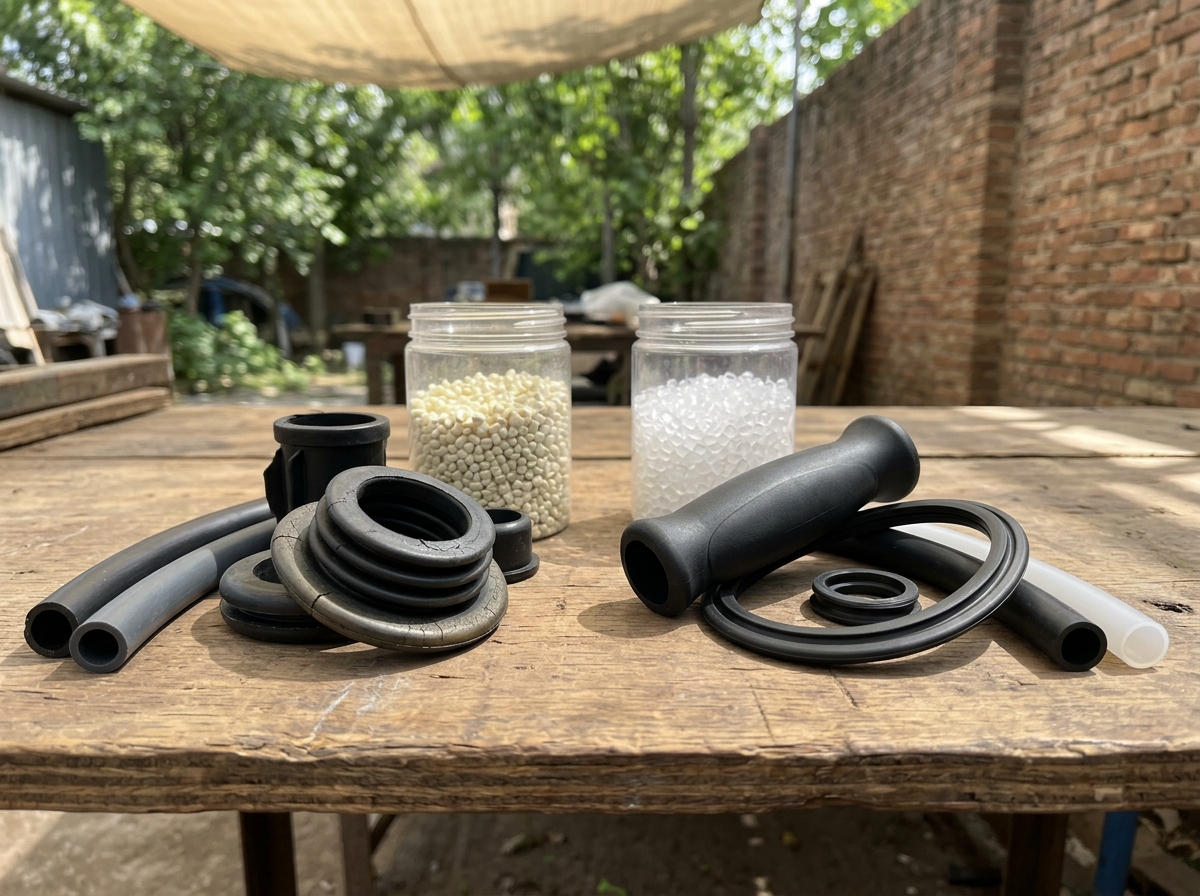

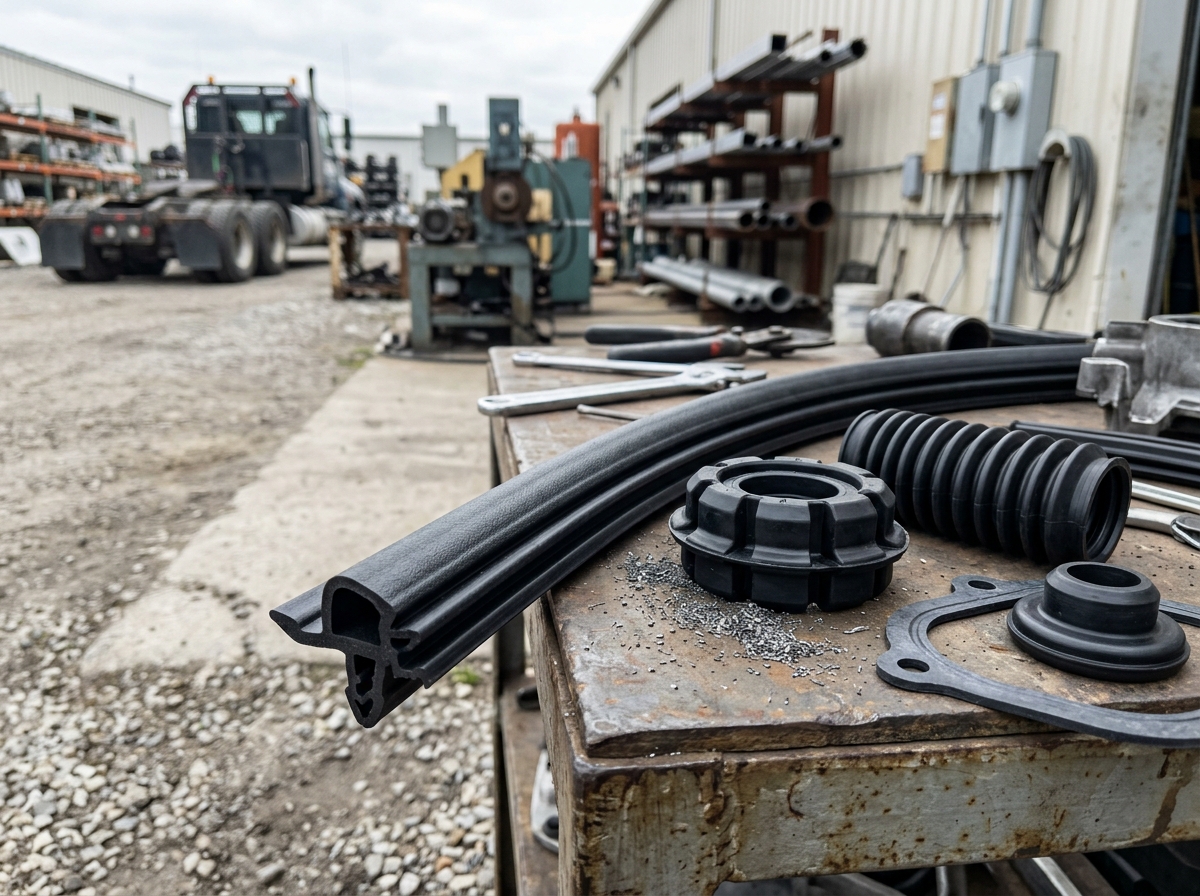

TPV thermoplastic vulcanizate is often the better choice for automotive seals when heat resistance, compression set control, weathering, and long service life matter more than the lowest material cost. Its rubber phase is dynamically vulcanized inside a thermoplastic matrix, so it can combine elastomeric recovery with easier processing than many conventional rubbers. In automotive sealing, that balance matters for weather strips, glass run channels, HVAC seals, and under-hood gaskets exposed to heat cycling, oil mist, ozone, and repeated compression. For buyers comparing TPV material for automotive seals with TPO, TPR, or SEBS blends, the key question is not only softness, but whether the part can keep sealing force after thousands of heat-and-load cycles. TPV usually wins in demanding sealing environments.
- TPV is designed for better heat resistance and compression-set performance than many standard TPE options in sealing applications.
- Automotive seals need more than flexibility; they need dimensional recovery, low fogging risk, and resistance to weathering and aging.
- Selection should be based on service temperature, compression set, dynamic durability, and the processing route, not price alone.
- For B2B buyers, TPV is often the most balanced material for OEM and aftermarket automotive sealing parts that face thermal and mechanical stress.
- Specification-driven sourcing works best when the supplier can support OEM tolerances, testing, and stable batch consistency.
TPV material for automotive seals is widely chosen because it bridges the gap between elastomer performance and thermoplastic processing efficiency, and that matters in a market where dimensional stability and heat resistance are non-negotiable. Automotive sealing systems are commonly validated against temperature cycling, ozone exposure, and compression-set testing, with dimensional tolerances often managed in the micrometer range; for example, ISO 3302-1 defines dimensional tolerances for vulcanized rubber parts by precision class, while ISO 815-1 specifies compression-set testing conditions for rubber and thermoplastic elastomers. For buyers evaluating polymer supply options, TPV grades, and adjacent elastomer families such as SEBS or TPO, the real decision is how the material behaves after heat aging, dynamic deformation, and long-term sealing load.
Why TPV material for automotive seals outperforms many TPE alternatives
TPV is better for many automotive seals because its vulcanized rubber phase gives it stronger elastic recovery under heat and compression than many non-vulcanized TPE compounds.
In simple terms, a seal must spring back after being squeezed for years, not just feel soft on day one. TPV is built for that job. The dynamic vulcanization process creates a fine rubber-in-plastic morphology, so the part can be extruded or molded like a thermoplastic while keeping many of the recovery benefits associated with rubber. That is why TPV is common in weather seals, beltline seals, window seals, air ducts, and gaskets that see repeated thermal expansion and contraction.
By contrast, lighter-duty TPEs may be excellent for comfort, grip, or appearance, but they can be less robust under prolonged heat. TPR can offer attractive softness and easy processing, yet it is usually selected for consumer goods, shoe components, and tool grips rather than demanding automotive sealing. SEBS-based compounds can deliver better weatherability than SBS, but they still require careful formulation when the application demands high heat resistance and low compression set.
| Material family | Typical strength | Typical limitation | Best-fit use |
|---|---|---|---|
| TPV | Heat resistance, elastic recovery, dynamic durability | Usually higher cost than basic TPE blends | Automotive seals, gaskets, HVAC duct seals |
| TPO | Lightweight, cost-sensitive processing | Lower sealing performance under sustained load | Interior/exterior trim, non-critical parts |
| TPR/TR | Soft feel, easy molding | Less suited for high-temperature sealing | Shoes, grips, consumer housings |
| SEBS blends | Good weatherability and flexibility | Heat and compression set depend heavily on formulation | High-end flexible compounds, modifiers |
For OEM buyers, the practical takeaway is clear: if the seal must survive engine-bay heat, solar loading, or repeated opening and closing, TPV is usually the safer technical choice. If the part is mainly decorative or load-bearing only in a mild environment, a cheaper TPE family may be enough.
Heat resistance in TPV thermoplastic vulcanizate and why it matters in vehicles
Heat resistance is the main reason TPV stands out in automotive sealing because heat is what gradually destroys sealing force, surface stability, and long-term fit.
A vehicle seal does not fail all at once. It fails slowly through creep, compression set, embrittlement, gloss change, cracking, and loss of rebound. Those problems become worse when the part is exposed to hot-cold cycling, UV radiation, moisture, road chemicals, and mechanical vibration. In real vehicle platforms, the seal may be asked to perform for years with limited maintenance, so the acceptable property window is narrow.
According to the ISO 815-1 compression-set test framework, elastomer performance is measured after controlled compression at specified temperatures and durations. That is important because compression set is one of the most direct indicators of whether a seal will keep applying force after long service. For temperature exposure, automotive test programs often pair such material tests with heat-aging and weathering protocols rather than relying on one data point alone.
In many automotive sealing systems, the processing temperature window also matters. TPV can often be processed on standard thermoplastic equipment, which makes high-volume extrusion and injection molding more efficient than many rubber curing routes. That can reduce cycle complexity and support consistent cross-sectional geometry, especially in long profile seals where uniform wall thickness is critical.
| Performance factor | Why it matters | Common evaluation method | Indicative result target |
|---|---|---|---|
| Compression set | Seal force retention | ISO 815-1 | Lower is better for long-term sealing |
| Heat aging | Prevents hardening and shrinkage | Oven aging, post-test tensile and hardness checks | Minimal property drift after exposure |
| Ozone resistance | Protects against surface cracking | Ozone chamber testing | No visible cracking after exposure |
| Dynamic fatigue | Supports repeated door and glass movement | Flexing and cyclic compression tests | Stable recovery after repeated cycles |
A useful benchmark for product development is to compare material retention before and after aging rather than looking only at initial hardness or tensile strength. That is why technical buyers should ask for post-aging data, not just a fresh-data sheet.
Automotive seals: where TPV performs best in real applications
TPV performs best in automotive seals that need flexibility, surface durability, and sustained recovery under repetitive load.
Typical application zones include door seals, trunk seals, glass run channels, roof ditch seals, HVAC duct seals, wire and cable boots, and under-hood edge seals. In these locations, the material must flex easily during assembly, maintain contact pressure in service, and resist long-term environmental exposure. For many of these parts, extrusion quality and dimensional consistency matter as much as the polymer itself.
One reason TPV is attractive to manufacturers is that it can support efficient extrusion runs for complex profiles. Automotive seals often include multi-lip geometries, hollow chambers, or soft-touch surfaces bonded to harder carriers. A thermoplastic route can simplify secondary operations and improve throughput compared with traditional rubber curing workflows.
For suppliers, the real commercial value is not just material availability, but process stability. A stable TPV grade can reduce variation in durometer, shrinkage, and fit-up, which lowers the risk of assembly complaints and warranty claims.
| Seal type | Main stress | Why TPV helps | Selection note |
|---|---|---|---|
| Door weather strip | Compression and UV exposure | Good recovery and weathering balance | Check surface finish and hardness stability |
| Glass run channel | Sliding friction and temperature cycling | Supports low deformation over time | Test friction and wear together |
| Trunk seal | Long-term compression | Helps preserve closing force | Prioritize compression set data |
| HVAC duct seal | Heat and airflow vibration | Maintains fit and flexibility | Confirm odor and fogging requirements |
In procurement, this means the best TPV grade is not the one with the highest headline softness, but the one that matches the actual duty cycle of the seal.
What the standards say about TPV and automotive sealing validation
Standards matter because automotive seals are judged by repeatable test methods, not by marketing language.
For dimensional control, rubber and elastomer parts are often referenced against ISO 3302-1, which classifies tolerance grades for molded and extruded components. For compression-set behavior, ISO 815-1 defines how elastomeric materials are compressed and measured after thermal exposure. For tensile properties, ISO 37 is the widely used standard for vulcanized rubber and thermoplastic elastomers. These standards do not tell a buyer which compound to purchase, but they do define how to compare candidates fairly.
The reason this matters in automotive sourcing is simple: a TPV compound that looks acceptable in the lab can still fail if it cannot pass the vehicle program’s full validation sequence. A practical validation plan usually includes:
- Incoming material verification against the supplier’s technical data sheet.
- Dimensional inspection of extruded or molded samples.
- Compression-set testing after thermal aging.
- Weathering, ozone, and fluid exposure checks.
- Assembly fit and functional testing in the target seal profile.
If you are comparing suppliers, ask whether they provide lot traceability, post-aging mechanical data, and application-specific test recommendations. That is often where serious polymer partners differentiate themselves from commodity resellers.
How TPV compares with TPO, TPR, SBS, and SEBS in procurement decisions
TPV should be chosen for performance-critical seals, while other elastomer families are better suited to lighter-duty or cost-led applications.
A common mistake is to compare materials only by softness or price per kilogram. That approach ignores the service environment. TPO is often strong in lightweight automotive trim and general molded parts, but it is not usually the first choice when compression set and heat resistance dominate. TPR is valued for soft touch and easy processability, yet it is more often used in consumer and footwear markets. SBS is widely used in adhesives and modified materials, but it is not generally the preferred base polymer for demanding automotive sealing. SEBS is a higher-performance styrenic block copolymer with better weatherability than SBS, and it can be useful in premium flexible compounds, though formulation still determines final heat performance.
| Material | Main advantage | Main risk in seals | Typical decision driver |
|---|---|---|---|
| TPV | Heat resistance and recovery | Cost above commodity blends | Long service life |
| TPO | Low density and cost balance | Compression-set limits | Weight and economics |
| TPR | Soft feel and easy molding | Lower thermal robustness | Comfort and appearance |
| SEBS | Weatherability and flexibility | Performance depends on compound design | Premium flexible formulations |
The best sourcing question is not “Which polymer is best overall?” It is “Which polymer holds sealing force under my exact temperature, compression, and durability profile?” For automotive seals, TPV usually answers that question most convincingly.
Processing advantages that make TPV practical for high-volume automotive manufacturing
TPV is practical because it supports thermoplastic-style processing without abandoning rubber-like performance.

That combination is valuable in modern automotive plants and tiered supply chains. Extrusion and injection molding can be integrated into established production lines, and scrap handling is generally simpler than with fully cured rubber systems because reprocessability is often possible within controlled limits. In real manufacturing, those advantages can shorten development cycles and reduce the number of process bottlenecks.
For high-volume sealing profiles, the ability to maintain stable melt behavior and consistent profile geometry is important. Processing stability helps reduce flash, uneven wall thickness, and post-shrink distortion. These are not cosmetic issues; they affect assembly force, noise isolation, and water-tightness.
The process window is still grade-dependent. Buyers should not assume that all TPV compounds behave the same. Filler loading, oil content, hardness target, and polymer ratio all influence flow, surface quality, and final mechanical response. That is why a custom or OEM-oriented grade is often preferable when the seal is critical.
Selection checklist for TPV material for automotive seals
The right TPV grade is selected by service condition first and by price second.
- Define the maximum service temperature and thermal cycle profile.
- Specify the required compression set, hardness, and recovery behavior.
- Confirm exposure to ozone, UV, oils, coolants, and cleaning chemicals.
- Match the processing route to extrusion or injection molding requirements.
- Request post-aging test data, not only virgin material properties.
- Review dimensional tolerance capability against the seal geometry.
- Verify whether the supplier can support custom color, odor control, or regulatory requirements.
For sourcing teams, one useful commercial practice is to compare two to three candidate grades under the same lab and pilot-line conditions. This is often more informative than comparing catalog numbers alone.
When TPV is the wrong choice
TPV is not always the best material, even for automotive-related parts.
If the application is extremely cost-sensitive and exposed only to mild temperatures, a TPO-based solution may be more economical. If the part requires a very specific soft-touch feel and lower thermal stress, TPR may be acceptable. If the main requirement is adhesive compatibility or modification of other polymers, SBS or SEBS may fit better as blend components rather than standalone seal materials.
The wrong choice usually happens when the buyer overvalues initial softness and undervalues long-term recovery. A seal that closes well in the first month but loses force after aging is a false economy. In vehicle platforms, that can translate into wind noise, water ingress, vibration complaints, and warranty cost.
That is why TPV is often recommended as the default technical benchmark for serious automotive seals, especially when heat resistance and durability are central requirements.
Buying signals that indicate a reliable TPV supplier
A reliable TPV supplier demonstrates consistency, technical support, and application understanding.
Look for clear technical documentation, stable lot-to-lot performance, and the ability to discuss test methods rather than only offer a price. In a global B2B environment, that usually means the supplier can support OEM and customized requirements, batch traceability, and commercial lead times without sacrificing material consistency. For buyers who need a broader portfolio, it also helps when the supplier can coordinate related materials such as SEBS compounds, TPO compounds, and general TPE materials through a single procurement workflow.
At a minimum, ask for:
- Technical data sheets with test methods and units.
- Heat-aging and compression-set evidence.
- Dimension and processability guidance for extrusion or molding.
- Regulatory documentation where needed for export programs.
- Sample support for pilot testing before mass approval.
That procurement discipline reduces surprises and helps the final part perform as expected in the field.
Conclusion: why TPV is better for automotive seals and heat resistance
TPV is better for automotive seals and heat resistance because it gives manufacturers a practical balance of elastic recovery, thermal stability, and thermoplastic processing efficiency.
For seals that face compression, heat cycling, and environmental aging, TPV generally offers a more reliable service-life profile than many softer or lower-cost TPE alternatives. It is especially valuable where compression set, weathering, and dimensional retention are tied directly to vehicle quality and warranty risk. If the application is a critical automotive seal, TPV is often the material most likely to deliver consistent performance across production, assembly, and long-term use.
FAQ
What makes TPV better than standard TPE for automotive seals?
TPV is better because its dynamically vulcanized rubber phase typically gives it stronger recovery and better heat resistance than many standard TPE blends in sealing applications.
Is TPV suitable for under-hood automotive parts?
TPV can be suitable for some under-hood seals and gaskets, but the exact grade must be checked against the temperature, oil exposure, and compression requirements of the part.
How is TPV compression set tested?
Compression set is commonly evaluated using ISO 815-1, which measures residual deformation after controlled compression and thermal exposure.
Can TPV replace EPDM in automotive seals?
In some sealing applications, TPV can be considered as an alternative, but the final choice depends on heat resistance, weathering, cost, and processing priorities.
Why do buyers prefer TPV for extruded seal profiles?
Buyers often prefer TPV because it supports efficient extrusion, stable geometry, and consistent recovery in long-profile sealing parts.
What should I ask a TPV supplier before ordering?
Ask for compression-set data, heat-aging results, dimensional tolerance capability, and support for your specific sealing environment and process route.
Is TPV better for automotive seals than TPO?
For critical sealing performance, TPV is usually better than TPO because it tends to provide stronger long-term recovery and heat resistance under load.